In every corner of life—whether personal, professional, or social—effective decision-making plays a central role. The ability to make sound, timely, and thoughtful choices not only boosts confidence but also shapes the trajectory of careers, relationships, finances, and personal fulfillment. Yet in a world overflowing with data, distractions, and opinions, making the right decision often feels like navigating through fog. Fortunately, decision-making is a skill that can be learned, honed, and mastered through practical techniques and mental frameworks.
From CEOs and entrepreneurs to students and creatives, the most successful people in any field often attribute their progress to the consistent use of decision-making strategies that reduce uncertainty and enhance clarity. Whether you’re facing a career crossroads, trying to weigh the pros and cons of a financial investment, or simply struggling to decide what’s next in life, knowing how to improve decision-making skills can dramatically reduce stress and lead to better outcomes.
This guide explores the top 10 techniques to improve decision-making, each offering a different perspective and practical approach. These strategies go beyond generic advice and provide actionable insights grounded in psychology, behavioral science, and real-world experience. By integrating even a few of these techniques into your daily decision process, you can sharpen your judgment, minimize regrets, and make choices with greater ease and certainty. Let’s dive into the practices that can help you make better decisions with confidence and clarity.
10. Conduct Post-Decision Reviews to Refine Strategy
To continually improve decision-making, one of the most valuable techniques is conducting post-decision reviews. After a significant choice has been made and enough time has passed to observe its outcomes, review the entire process. What went well? What didn’t? Were there warning signs or unexpected wins?
This is not about placing blame—it’s about learning. By documenting your thought process, initial expectations, and real-world results, you develop a feedback loop that enhances future decisions. It’s a critical habit among top performers in fields ranging from entrepreneurship to sports to medicine.
Post-decision reviews build self-awareness and strategic discipline. They help refine your internal compass, identify recurring errors, and celebrate accurate predictions. Over time, this continuous improvement loop turns good decision-makers into exceptional ones. If you’re serious about growth, take time to deconstruct your decisions and learn from the journey.
9. Consult Diverse Perspectives to Challenge Bias
We all carry unconscious biases that can cloud judgment. A proven way to enhance decision-making is by seeking input from diverse perspectives. Consulting people with different backgrounds, experiences, or opinions exposes you to blind spots and offers alternative interpretations of the same data or situation.
Whether you're managing a team, investing money, or choosing a life path, involving others in the decision process ensures that you're not locked into an echo chamber. It also promotes collaborative decision-making, which often leads to more sustainable and inclusive outcomes.
This method doesn't mean relinquishing control—it means enhancing clarity. By combining your instincts with external viewpoints, you expand the information set and reduce error-prone assumptions. Surrounding yourself with honest, knowledgeable voices will help you make more balanced and inclusive decisions that stand the test of time.
8. Apply Mental Models to Reframe Decisions
Mental models are frameworks for thinking that help simplify complex problems. Using mental models for decision-making allows you to see problems from different angles and avoid cognitive traps. Popular models include first principles thinking, opportunity cost analysis, inversion, and second-order consequences.
For instance, first principles thinking breaks a decision down to its foundational truths and builds up from there. If you’re debating whether to buy or rent a home, instead of relying on conventional wisdom, you strip the problem to core assumptions like financial flexibility, long-term goals, and personal lifestyle preferences.
Inversion, another powerful model, involves thinking about what would guarantee a bad result and then working backward to avoid those actions. It shifts your focus from chasing success to avoiding failure, which is often more practical.
Learning and applying mental models consistently can sharpen decision-making across industries, relationships, and life planning. They challenge assumptions, foster critical thinking, and provide a structure for making more rational and calculated choices.
7. Practice Delayed Decision-Making for Complex Choices
Rushing into a big decision often leads to regret. One powerful method to improve decision-making is practicing delayed or intentional decision-making, which involves setting a specific time to revisit a choice instead of deciding in haste. This pause allows emotions to settle and gives your subconscious time to process information in the background.
This technique is effective for emotionally charged decisions, such as ending a relationship or making a large purchase. By stepping back and giving yourself a “decision deadline”—such as 24 or 72 hours—you avoid impulsiveness while staying proactive. This method enhances emotional clarity and cognitive balance, two essential ingredients in smart decision-making.
It’s also useful in negotiations, where taking time can shift power dynamics in your favor. Even a brief pause to consult with others, reflect, or sleep on it can reveal insights that were previously obscured. Delayed decision-making is not indecision—it’s strategic patience that often leads to better outcomes.
6. Incorporate Data and Intuition for Balanced Decisions
While data-driven decisions are crucial, the role of intuition in decision-making should not be underestimated. The most effective decision-makers blend hard facts with gut feelings. This approach is especially helpful when data is incomplete, contradictory, or overly complex. The key lies in using intuition as a supplement—not a substitute—for logical thinking.
For instance, imagine you’re choosing between two equally qualified job candidates. Data such as experience, references, and skill assessments might not show a clear winner. In this situation, your intuitive sense of which candidate better aligns with the team’s culture could be the deciding factor.
Intuition draws from accumulated experience and subconscious pattern recognition, making it particularly valuable in high-stakes or ambiguous decisions. Combining it with analytics allows you to avoid decision paralysis and build confidence. The integration of data and intuition creates a holistic decision-making model that adapts to real-world complexity and nuance.
5. Tap Into Scenario Planning to Visualize Outcomes
One of the most practical yet underused techniques to improve decision-making is scenario planning. This involves visualizing multiple outcomes for a decision—best case, worst case, and most likely case. By walking through each scenario in detail, you get a better sense of potential risks and rewards, which sharpens your ability to choose wisely.
For example, if you're considering launching a side business, the best-case scenario might be achieving financial independence, while the worst-case could involve a modest financial loss and time spent. The most likely case might fall somewhere in between. Exploring these in advance not only helps reduce fear and uncertainty but also prepares you mentally and logistically for different results.
Scenario planning is widely used in strategic business decision-making, but it’s just as valuable for personal life choices. It forces you to confront possible pitfalls while also remaining optimistic and prepared. This technique gives your decision-making process a balance of optimism and realism, reducing blind spots and emotional biases.
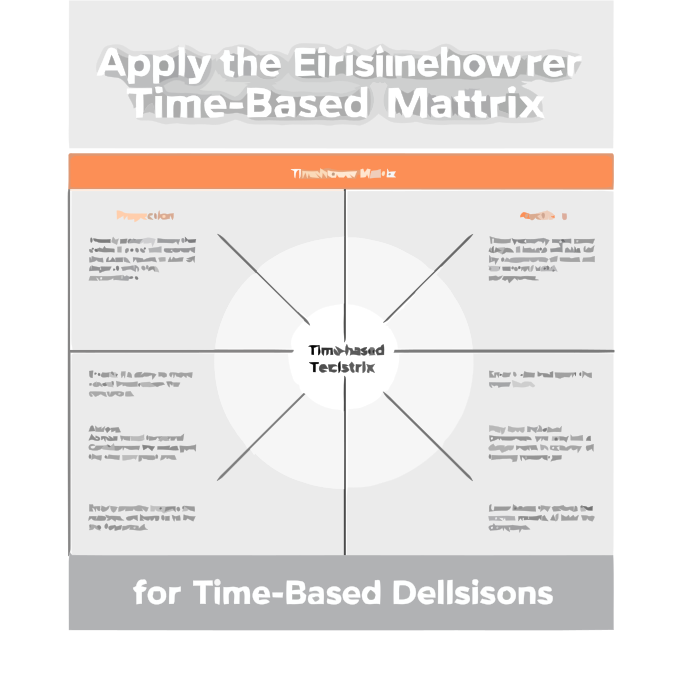
4. Apply the Eisenhower Matrix for Time-Based Decisions
When faced with too many tasks or options, the Eisenhower Matrix is a time-tested strategy to help you prioritize decisions based on urgency and importance. Named after President Dwight D. Eisenhower, this decision-making framework sorts tasks into four quadrants: urgent and important, important but not urgent, urgent but not important, and neither urgent nor important.
This matrix helps in both daily productivity and long-term planning. For instance, “responding to a work emergency” might be urgent and important, whereas “planning for retirement” is important but not urgent. Identifying the quadrant a decision falls into allows you to allocate time, energy, and focus accordingly.
This technique is especially effective for decision-making under pressure, where everything can feel urgent. It reduces overwhelm and ensures that you’re not just reacting to noise but making space for strategic, value-aligned actions. By distinguishing between what’s urgent and what’s meaningful, the Eisenhower Matrix allows you to make more deliberate and impact-driven decisions.
3. Leverage the Power of Pros and Cons Lists—But Add Weighting
Everyone knows about making pros and cons lists to improve decision-making, but most people don’t take this technique far enough. A more advanced method involves not only listing benefits and drawbacks but also assigning a value or weight to each item based on its importance. This transforms a subjective process into a more data-informed approach, offering clearer insights.
Let’s say you're considering moving to a new city. A basic pros and cons list might include things like “closer to friends” or “higher cost of living.” But by assigning numerical weights to these items—perhaps a “10” for being near loved ones and a “4” for cost—you get a better sense of what truly matters in the big picture. This creates a prioritized framework for decision-making rather than a flat list.
This technique is particularly useful for complex decisions with multiple variables, like career shifts, home purchases, or business investments. It can also help reduce indecision and anxiety by making abstract concerns more concrete and measurable. By adding structure and depth to a familiar method, weighted pros and cons lists can significantly improve your decision-making clarity and accuracy.
2. Use the 10/10/10 Rule to Gain Perspective
Developed by business author Suzy Welch, the 10/10/10 Rule is a simple but highly effective decision-making framework. It works by pushing you to consider the short-term, mid-term, and long-term consequences of your choices. Specifically, ask yourself: How will I feel about this decision 10 minutes from now, 10 months from now, and 10 years from now?
This technique enhances rational decision-making by helping you break free from the emotional weight of the moment. It is particularly useful for people who struggle with impulsive or emotionally driven decisions. For instance, imagine you're tempted to send a heated email in response to a colleague's criticism. Applying the 10/10/10 rule forces you to recognize that while the message might feel satisfying in the short term, it could harm relationships or your professional reputation down the line.
This method helps you avoid short-sighted mistakes and develop a long-range view of consequences. It’s equally helpful for positive decisions too, such as starting a new habit or investing in personal growth. By projecting yourself into the future, you create emotional distance from immediate pressures, allowing your decision-making process to be more objective and intentional. The 10/10/10 Rule enhances your ability to choose wisely, not just quickly.
1. Clarify Your Core Values Before Making Big Choices
One of the most overlooked yet powerful techniques to improve decision-making is to start by identifying and aligning with your core personal values. Every decision you make—big or small—is an extension of what matters most to you. When your choices reflect your values, you not only feel more at peace with the outcome but also reduce internal conflict and long-term regret.
To apply this technique, take time to articulate what you truly care about. These could include integrity, freedom, stability, family, creativity, or impact. For example, if you’re debating between a high-paying job that requires relocation and a lower-paying role that allows you to stay close to loved ones, understanding that “family” is a top value could tip the scales in favor of the latter.
This method helps eliminate options that may look appealing on the surface but conflict with your long-term sense of fulfillment. It provides a decision-making compass that keeps you grounded and emotionally aligned with your choices. The more frequently you make values-based decisions, the more confident and consistent your decision-making will become. This technique is especially useful in emotionally charged or high-pressure situations, where distractions can blur judgment. Clarifying values improves decision-making by keeping you centered on what truly matters.
Final Thoughts
Mastering decision-making isn’t about eliminating risk or always knowing the perfect answer. It’s about building a process, developing habits, and using intentional strategies to improve decision quality over time. The techniques explored in this guide—from clarifying values to post-decision reviews—each offer a powerful way to sharpen your thinking, reduce stress, and approach complex situations with clarity.
In both personal and professional contexts, your ability to make good decisions is directly tied to your growth, confidence, and success. Whether you're leading a team, navigating relationships, or planning your future, applying even a few of these techniques consistently can lead to more confident, informed, and empowered decision-making.
Remember, great decision-makers aren’t born—they’re developed through practice, reflection, and the right tools. By embracing these techniques and continually refining your approach, you give yourself the best possible chance of choosing wisely, leading effectively, and living fully. Let every decision become a stepping stone toward a more intentional and fulfilling life.
Join thousands of readers who get the best Top 10 lists delivered directly to their inbox every week. Stay updated on trending topics, expert picks, and exclusive insights.