Top 10 Techniques for Creative Thinking
March 24, 2026
In a world where innovation is the currency of progress, creative thinking has become an essential skill across every field—from business and technology to education, art, and daily problem-solving. Yet creativity isn’t limited to the naturally gifted or those in traditionally artistic careers. It’s a skill anyone can cultivate with the right tools and mindset. Whether you're an entrepreneur trying to develop new products, a content creator seeking fresh ideas, or simply someone aiming to approach challenges more imaginatively, understanding the top techniques for boosting creative thinking can transform the way you think and work.
Creativity thrives when the mind is encouraged to explore, play, and make unexpected connections. But in our hyper-structured and distraction-filled lives, tapping into that deeper well of ideas can often feel elusive. That’s where intentional techniques come in—methods that not only encourage originality but also break mental ruts and reframe problems in empowering ways.
In this article, we’ll dive into the top 10 proven techniques to enhance creative thinking, each one designed to spark your imagination, unlock new possibilities, and bring greater depth to your ideas. These methods aren’t theoretical fluff—they’re practical, adaptable, and ready to implement into your workflow. No matter your industry or goal, embracing these strategies can help you think more freely, problem-solve more effectively, and express yourself with greater originality.
10. Journaling for Reflective Creative Exploration
In the fast-moving digital age, journaling remains one of the most powerful techniques for developing creative thought and clarity. It allows for deep reflection, emotional processing, and uninterrupted ideation. By writing regularly, you create a sacred space where ideas grow, patterns emerge, and insights surface.
Unlike formal writing, creative journaling is unfiltered. You can brainstorm, doodle, list, explore questions, or simply reflect on your day. The act of putting thoughts to paper (or digital doc) slows the mind and gives your ideas room to breathe.
Journaling is particularly effective for creative self-discovery, problem reframing, and vision mapping. It can help you uncover subconscious patterns, track creative progress, and develop new projects organically. Many creatives use it as a morning ritual to clear mental clutter and invite new ideas.
Try prompts like “What new idea did I encounter today?” or “What problem am I avoiding and why?” The more you journal, the more creative your thinking becomes—not because ideas appear instantly, but because journaling builds inner awareness and creative flow.
9. The “Six Thinking Hats” Approach for Structured Ideation

Devised by Edward de Bono, the “Six Thinking Hats” technique allows for a comprehensive creative exploration of a problem or idea by adopting six different mindsets—symbolized by colored hats. Each hat represents a way of thinking: logic (white), emotion (red), caution (black), optimism (yellow), creativity (green), and process (blue).
This method encourages participants or individuals to examine ideas from multiple angles—removing bias and deepening creative analysis. For instance, the green hat sparks wild, innovative ideas; the black hat questions risks; the yellow hat explores value and benefit.
By cycling through these modes intentionally, you create a balanced creative environment where ideas are not judged too early, but also not accepted blindly. It improves group collaboration, strengthens ideation, and avoids premature decision-making.
Whether used in group meetings or solo journaling sessions, the Six Hats provide mental structure to creativity. They ensure your thinking is both wide and deep, imaginative and strategic. This technique is ideal for product development, content planning, and strategic design.
8. Random Stimulus Brainstorming for Unexpected Ideas

Sometimes, the mind needs a jolt to shake free from conventional thinking. Random stimulus brainstorming introduces unrelated prompts—images, words, sounds, or objects—into your creative process to spark original ideas and new associations.
This method works because the brain naturally seeks patterns. When faced with a random element, your mind tries to make sense of it in context with your challenge. That effort often leads to novel insights you wouldn’t have uncovered otherwise.
Start by picking a random image, phrase, or word from a book, card deck, or online generator. Then ask yourself: How does this relate to my current problem? How might this be used metaphorically in my project? What qualities of this object could inspire a solution?
This technique is playful, spontaneous, and especially useful during idea droughts. It’s great for visual thinkers and works beautifully in creative workshops. Over time, random stimulus brainstorming trains your brain to see possibilities in everything, a hallmark of creative fluency and mental flexibility.
7. Lateral Thinking for Nonlinear Problem Solving

Lateral thinking is the cornerstone of nonlinear creative strategies. Coined by Edward de Bono, this method encourages breaking away from traditional logic and exploring indirect, often unexpected paths to problem-solving. It’s about shifting your thought pattern sideways instead of forward—making jumps, not steps.
Unlike vertical thinking, which focuses on refinement and correctness, lateral thinking embraces unusual associations and unpredictable connections. It often involves challenging assumptions, asking absurd questions, or juxtaposing unrelated concepts to trigger new insights.
For example, instead of asking, “What features should this app have?” you might ask, “What would this app look like if it were a museum exhibit?” Such leaps don’t provide direct answers—but they stimulate idea generation from a broader canvas.
To practice lateral thinking, introduce exercises that disrupt logic. Use metaphor-based ideation, random word prompts, or analogies from unrelated fields. This taps into your subconscious and leads to solutions that are both imaginative and practical.
When you consistently engage in lateral thinking, your brain becomes more agile. You develop the ability to switch perspectives rapidly, making you a better ideator, strategist, and communicator. Lateral thinking is especially crucial for innovation, marketing, and any field where creative agility sets you apart.
6. Constraint-Based Thinking to Ignite Resourcefulness

It might sound counterintuitive, but imposing limitations can actually boost your creative potential. When you’re faced with infinite choices, the mind often stalls. But when you introduce constraints—time, budget, materials, or even word count—you trigger innovation through necessity.
Constraint-based thinking pushes you to use what's available in inventive ways. A filmmaker with a small budget finds clever visual tricks. A writer with a 100-word limit crafts a tighter, more impactful message. A designer with one color explores texture and shape more deeply.
This technique is rooted in the idea that boundaries spark focus. When you're forced to work within specific limits, you abandon perfectionism and engage your problem-solving muscles more fully. Creativity thrives when it’s challenged.
To apply this, set artificial constraints for your next project. Limit your brainstorming session to only analog solutions. Try building a concept in 30 minutes. Or solve a problem using only three materials. You’ll be surprised how quickly these restrictions transform into creative breakthroughs. Resourceful creative thinking under pressure is a powerful way to develop ideas you may never have reached with complete freedom.
5. Role-Playing and Perspective Shifting for Fresh Insights

One of the most exciting ways to unlock creative ideas is to step into someone else’s shoes—literally or metaphorically. Perspective shifting, or role-playing, involves imagining how different people or characters might approach your challenge. This technique broadens your mental lens and introduces alternative viewpoints for creativity.
Imagine you're designing a product. What would a child think of it? How would a minimalist use it? What would a historical figure do differently? By exploring these questions, you access mental territory that’s normally outside your range. It’s especially helpful when creating content, designing services, or solving human-centered problems.
Role-playing can be extended into group activities where participants adopt various personas to evaluate or pitch ideas. This builds empathy, breaks assumptions, and stimulates imagination. When you begin to think like someone else, you challenge your own biases and generate more inclusive, multidimensional ideas.
Perspective shifting also enhances storytelling, writing, and branding. It allows you to appeal to diverse audiences and understand hidden motivations. In essence, the more perspectives you explore, the wider your creative thinking toolkit becomes.
4. Daydreaming with Purpose to Access Deeper Ideas

In a culture obsessed with productivity, daydreaming often gets a bad reputation. But neuroscience tells a different story. When the brain enters a default mode network—the state associated with daydreaming—it begins to connect distant ideas, memories, and insights in surprising ways. This is where many of our best ideas are born.
The key is intentionality. Purposeful daydreaming means giving yourself space to relax, think freely, and mentally explore possibilities without pressure. Taking a walk without your phone, sitting by a window, or even staring at the ceiling can provide a mental playground for your creativity.
Many great inventors, writers, and thinkers have credited their breakthroughs to idle, reflective time. This is because during periods of low stimulation, the brain shifts into a mode where it sifts through existing information, reorganizes it, and creates new connections.
If you’re working on a complex project or seeking a unique solution, consider scheduling time for intentional daydreaming. Create environments that allow your mind to wander. Whether it’s a walk in nature or a moment of silence before sleep, these interludes unlock creative thinking through introspection and inner vision.
3. SCAMPER Method for Systematic Innovation
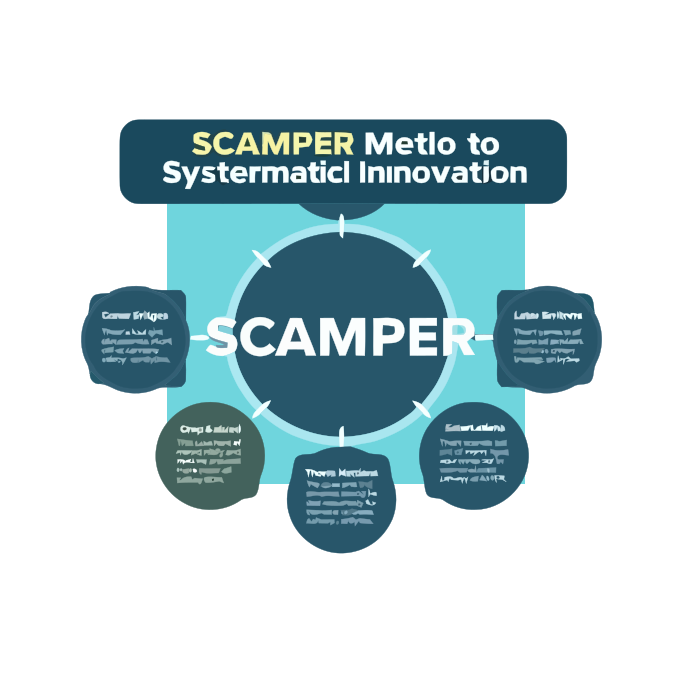
The SCAMPER technique is one of the most widely used frameworks in the world of creative problem-solving. It offers a structured way to approach innovation by prompting you to alter, rethink, and rebuild an existing concept or idea. SCAMPER stands for Substitute, Combine, Adapt, Modify, Put to another use, Eliminate, and Reverse.
Each of these prompts acts like a creative lens through which you analyze your project, product, or idea. For instance, what could you substitute in your current approach? What if you combined two unrelated features? Could you adapt a method from another industry? These questions are not only practical—they often lead to breakthroughs.
The SCAMPER method works especially well when you're improving something that already exists. It helps you build upon foundations rather than starting from scratch, making it ideal for innovation within business models, product design, or even storytelling.
Because SCAMPER prompts you to look at your idea from multiple directions, it fosters multi-dimensional creative thinking. It’s systematic yet open-ended, ensuring you don’t miss valuable angles during brainstorming sessions. Whether you're leading a team or working solo, SCAMPER provides a repeatable structure for fresh perspectives.
2. Reverse Thinking to Break Mental Patterns

Sometimes, the key to innovative thinking lies in flipping your perspective entirely. Reverse thinking is a technique where instead of asking how to solve a problem, you ask how to create the problem—or make it worse. This intentional inversion allows you to disrupt your normal problem-solving patterns and approach challenges from a radically different angle.
For example, instead of asking “How can I increase customer satisfaction?” you might ask, “How could I make my customers as unhappy as possible?” From that humorous or even absurd starting point, you'll uncover insights into potential blind spots, weaknesses, or unmet needs. You then reverse those discoveries to inform genuine improvements.
This method is especially powerful in group settings where thinking tends to converge. By introducing reverse thinking prompts, you create cognitive dissonance that forces the brain to stretch. It’s particularly useful in marketing, UX design, business strategy, and team innovation sessions.
The magic of reverse thinking is that it helps you break free from habitual thinking loops. It encourages curiosity, reflection, and experimentation. When you're stuck in a rut or can't see a new way forward, reverse the question—and you’ll often stumble upon ideas that feel truly original.
1. Mind Mapping to Unlock Visual Creativity

One of the most effective tools for generating creative ideas quickly is mind mapping. This technique taps into the brain’s natural preference for visual organization and nonlinear thinking. Unlike traditional lists, which move in straight lines, a mind map encourages you to branch out from a central idea, exploring related concepts, connections, and associations organically.
Start by writing your main topic or problem in the center of a blank page. Then draw lines outward to subtopics, ideas, or related themes. From those branches, continue expanding with further associations. This format visually mirrors the way thoughts naturally occur—making it easier to uncover connections you wouldn’t have found through linear thinking alone.
Mind mapping is especially useful for brainstorming, project planning, content creation, and breaking through mental blocks. It activates both the left and right hemispheres of the brain, combining logic with intuition. As you fill the page with branches, color codes, and sketches, you'll find that ideas begin to flow more freely.
This method is not only fast but also flexible. You can use it digitally with apps or stick to pen and paper. Either way, it’s a powerful tool to tap into visual creative thinking techniques and push beyond conventional boundaries. With regular use, mind mapping trains your brain to think in more expansive, interconnected ways.
Final Thoughts
Creative thinking is not an elusive talent reserved for a lucky few. It’s a muscle you can strengthen, a process you can guide, and a mindset you can adopt. The techniques shared here—from mind mapping and constraint-based ideation to journaling and role-playing—are practical, accessible tools that anyone can use to ignite innovation.
The secret to long-term creativity lies in consistency, curiosity, and courage. It’s about showing up regularly to experiment, explore, and question. It’s about creating environments where your imagination feels safe to play. Most of all, it’s about staying open—to ideas, to failure, to evolution.
When you integrate these top 10 techniques for creative thinking into your life, you’ll find yourself solving problems more intuitively, expressing ideas more boldly, and approaching challenges with renewed energy. Creative thinking isn’t a one-time event—it’s a lifelong skill that grows stronger the more you use it.
Embrace the practice. Feed your curiosity. And let your creativity reshape what’s possible.


